An annual spreadsheet became a shared, ongoing record.
Internal Performance Management System — built for Shipra Group, replacing HR-only, once-a-year reviews with a system employees and managers both see, all year round.
In internal testingTargeting full rollout by end of August 2026

What changed
Same conversation. Different record.
Before
One locked spreadsheet, once a year
- Metrics collated by hand into a sheet only HR could see in full
- Reviewed once, in a single annual one-on-one
- Feedback discussed in the room, never written down
- Agreed actions had no record to check against later
After
One shared record, kept all year
- Goals and metrics live in the system, not a separate sheet
- Reviews run on a cadence, not once a year
- Employee and manager see the same view
- Feedback and agreed actions are recorded, and checkable next time
The challenge
A conversation that disappeared the moment it ended
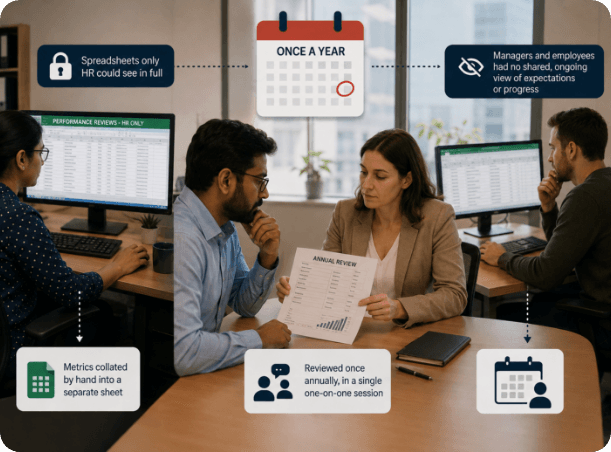
Performance reviews ran once a year, on spreadsheets that only HR could see in full. Managers and employees had no shared, ongoing view of expectations or progress. Metrics were collated by hand into a separate sheet, then reviewed once annually, in a single one-on-one session.
Neither the feedback discussed in that session, nor the actions agreed in it, were ever captured anywhere.
A year later, there was no record to check progress against — no visibility for the employee into how they were being evaluated, and no structured way to have the conversation more than once a year, even when it would have helped.
The approach
Built with Claude Code, in close collaboration with HR
One person built the system, working directly with HR to understand the existing process and spreadsheet formats, rather than working from assumptions. The existing spreadsheets and a detailed description of both the current process and what it needed to become were given as context to Claude Code.
What would traditionally have taken an estimated four to six weeks took about one week, start to finish.
What it does
Structured, shared, and running more than once a year
Metrics and expectations are captured directly in the system rather than living in a separate, manually maintained sheet. Both the feedback from a review and the actions agreed in it are recorded — so there's something to check progress against next time, not a conversation that disappears the moment it ends.
Shared visibility
Employee and manager work from the same view of goals, metrics, and expectations — not a sheet only one side can see in full.
Ongoing cadence
Reviews run more frequently than the old annual cycle, so conversations can happen when they'd actually help.
Feedback and actions, recorded
What was discussed and what was agreed are both written down — carried forward to the next review, not lost.
Why it matters
The goal wasn't just efficiency — it was culture.
Moving performance conversations from an opaque, once-a-year, HR-only process to something transparent and fact-based was meant to build trust and open up honest discussion between employees and managers — grounded in a shared record, rather than memory or a spreadsheet only one side could see.

Honest scope note
This is a transparency and workflow system, not an agentic one — it doesn't make autonomous decisions or run without a person driving each step.
It's proof of AI-assisted build discipline, not of agentic automation — scoped consistently with every other proof point on the site.